
EDP vs EDT vs extrait de parfum: what the labels mean
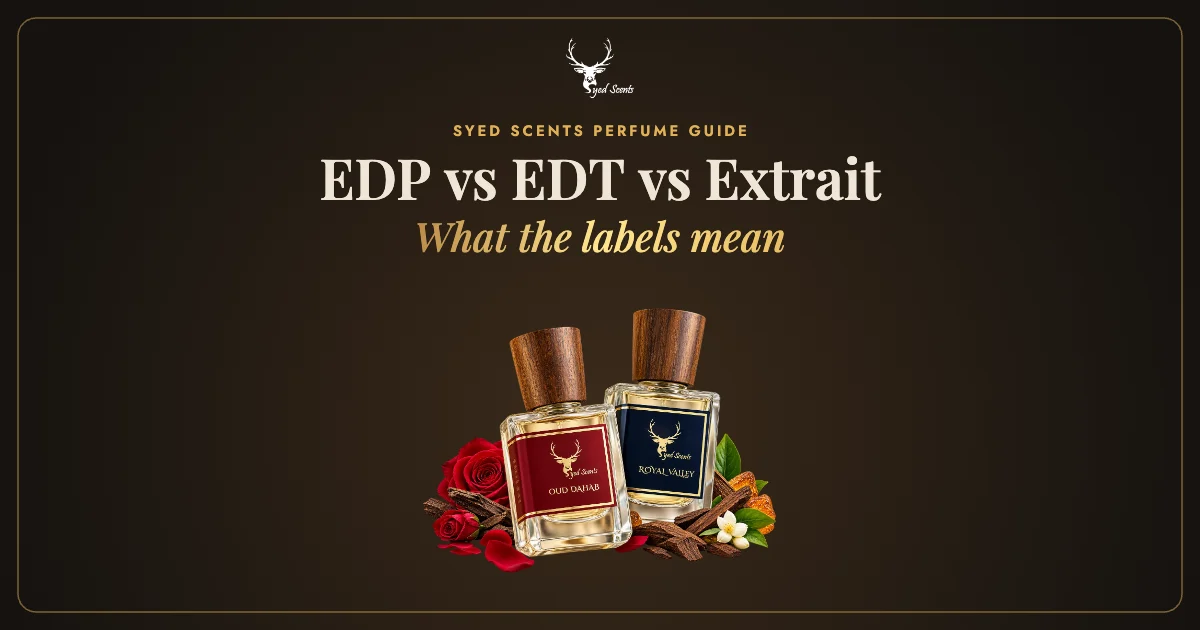
EDP means eau de parfum, a perfume with roughly 15–20% perfume oil. EDT (eau de toilette) is lighter at about 5–15%, and extrait de parfum is the strongest common label at 15–30% or more. More oil usually means a scent that lasts longer on skin. Labels are not regulated, though, so check the brand’s stated oil percentage.
You pick up a bottle and see three letters: EDP. Another says EDT, and a pricier one says Extrait. They can smell alike, so it’s fair to wonder what you’re paying for.
This guide explains each label in plain words, shows how much real perfume oil sits inside a 50 ml bottle at each strength, and helps you choose. We make two extrait perfumes ourselves, so we use them as the worked example.
- EDP is eau de parfum, usually about 15–20% oil.
- EDT is eau de toilette, usually about 5–15% oil.
- Extrait de parfum is the richest common label.
- More oil usually means longer wear, not a louder scent.
- Labels are loose; the stated oil percentage tells you more.
EDP means eau de parfum, a mid-to-high strength perfume
Eau de parfum is French for “perfume water”. It is a spray perfume made of perfume oil dissolved in alcohol, usually with a little water. Wikipedia’s summary of perfume strengths puts EDP at about 15–20% aromatic compounds, typically around 15%.
That makes EDP the strength most people mean when they say “a good perfume”. It is stronger than eau de toilette and lighter than extrait.
Every label is about how much perfume oil is inside
So the letters are really a rough measure of concentration. The rest of the bottle is mostly alcohol, which helps the scent spread and then evaporates. Sources give slightly different ranges, so here are two side by side.
| Label | Short form | Perfume oil (Wikipedia) | Perfume oil (Marie Claire) | Typical wear (Marie Claire) |
|---|---|---|---|---|
| Extrait de parfum / Parfum | P | 15–30% | 20–40% | 8–12+ hours |
| Eau de parfum | EDP | 15–20% | 15–20% | 6–8 hours |
| Eau de toilette | EDT | 5–15% | 5–15% | 3–5 hours |
| Eau de Cologne | EDC | 2–3% (2–5% on its own page) | 3–5% | Short |
Notice the overlap. Wikipedia itself says the terms are quite imprecise, because no law fixes them. A strong EDT and a light EDP can sit close together.
Extrait de parfum is the strongest label you will usually see
Extrait de parfum, often shortened to “parfum” or “extrait”, has the highest share of perfume oil. Wikipedia gives 15–30% and notes that the fragrance industry body IFRA describes it as typically about 20%. Marie Claire’s guide puts it higher, at 20–40%.
More oil usually means the scent stays on skin for longer. It also costs more to make, since perfume oil is the expensive part of the bottle.
Both of our perfumes are extraits with 30% perfume oil. Oud Dahab is a rose and oud perfume; our oud guide explains what an oud note is. Royal Valley is a darker amber and leather scent.
EDP and EDT differ in oil, wear time and price
EDP vs EDT is the comparison most people search. In short, EDP has more oil and usually lasts longer, while EDT is lighter and cheaper for the same bottle size.
Brands sometimes change the recipe too. An EDT version may lean on fresher top notes, and an EDP version on heavier base notes. That matters, because base notes are the large, slow-evaporating molecules that stay on your skin longest, as Wikipedia’s page on perfume notes explains. So two bottles with the same name can smell a little different.
Choose EDT if you want something light for hot days or the office. Choose EDP or extrait if you want one application to carry you through the day.
How many ml of real perfume oil you get
Here’s the simplest way to compare value. Multiply the bottle size by the oil percentage. We used our own 50 ml bottles and the typical figures from Wikipedia for the other labels.
Perfume oil in a 50 ml bottle
Typical EDP and EDT figures from Wikipedia, Perfume. Our extraits state 30% perfume oil on the product pages.
So a 30% extrait holds about twice the perfume oil of a typical EDP and three times that of a typical EDT. That doesn’t make it three times “better”. It simply tells you why extraits cost more and why you need fewer sprays.
Two myths about strong perfumes
“Stronger means louder.” Not really. More oil mostly means longer wear. How far a scent carries depends a lot on its notes and on how many sprays you use. One spray of an extrait can be quieter than four sprays of an EDT.
“Cologne is for men, parfum is for women.” The words describe strength, not gender. Eau de Cologne started as a light citrus water mixed by Johann Maria Farina in Cologne in 1709, according to Wikipedia’s Eau de Cologne page. In the US the word later became shorthand for men’s perfume, which is where the mix-up comes from.
How to choose a strength
Start with where you’ll wear it. For an air-conditioned office, a light EDT or one spray of an extrait is enough. For a wedding, a dinner or a long travel day, an EDP or extrait saves you from carrying the bottle.
Then check the label for a stated oil percentage. If a brand gives it, you can compare value with the simple sum above. If you prefer no alcohol at all, an oil-based attar is the other route; our guide to attar vs perfume compares the two.
What we tested
We wore both of our extraits on skin through a full day. Oud Dahab stayed noticeable for 10–12 hours and Royal Valley for up to 12 hours, which matches what we state on the product pages. Your result will depend on your skin, the weather and how many sprays you use. Our tips on making perfume last longer help with that.
Questions
Is parfum the same as extrait de parfum?
Yes. “Parfum”, “extrait” and “extrait de parfum” are names for the same top strength. Wikipedia lists a rarer “esprit de parfum” between EDP and parfum, but few brands use it.
Which lasts longer, EDP or EDT?
EDP usually lasts longer because it has more perfume oil. Marie Claire’s fragrance guide estimates about 6–8 hours for EDP and 3–5 hours for EDT, but skin type, weather and the notes in the scent change that a lot.
What does EDT mean?
EDT means eau de toilette, French for “grooming water”. Wikipedia notes it was once called “toilet water” in English. It is lighter than EDP and stronger than cologne.
How we made this guide
The Syed Scents team wrote this guide on 24 November 2026. We read each source on that day and linked it where we use it. Where sources gave different numbers, we show both. The wear times for our own perfumes come from our own wear test, checked by the owner.
Want help choosing? Message us on WhatsApp, or see all our attars and perfumes.
Sources
Shop the attars
More guides
 GuideHow to make perfume last longer in Indian weatherWhy perfume fades, the simple steps that make it last, our own 12-hour routine with two sprays, and how perfume…Read more
 GuideMitti Attar: The Smell of First Rain, ExplainedMitti attar is the smell of first rain on dry earth, distilled from baked clay into sandalwood oil in Kannauj.…Read more
 GuideOud Attar: Real Oud vs Oud Accord, Types and PriceReal oud is oil from rare agarwood; most oud attars use an oud accord. Here is the difference, what white…Read more