
Mitti Attar: The Smell of First Rain, Explained
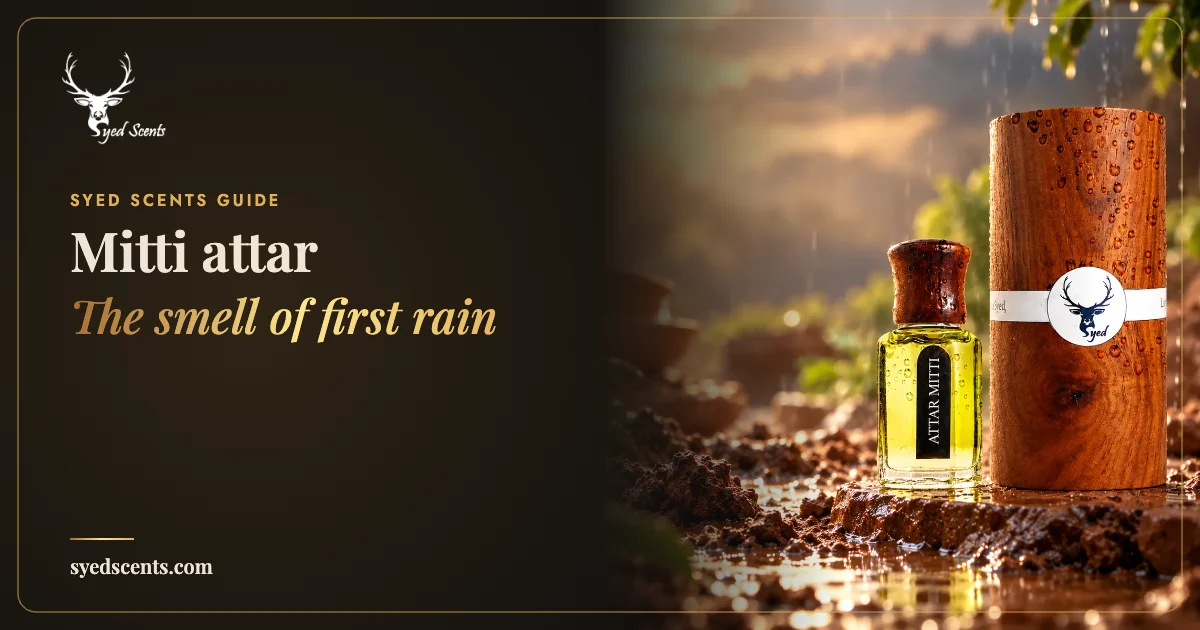
Mitti attar is an attar that smells like the first rain on dry earth. In Kannauj it is made by heating baked clay in a copper still (deg) and letting the vapour soak into sandalwood oil in a receiver (bhapka). It is a light, earthy, calm scent, good for daily wear in summer and before the monsoon.
- “Mitti” means soil and “attar” means perfume: mitti attar is the smell of wet earth in an oil.
- The smell of rain on dry ground has a name, petrichor, and a main molecule, geosmin, made by soil bacteria.
- Traditional mitti attar is distilled from baked clay into sandalwood oil by the deg-bhapka method in Kannauj.
- It is a light scent that sits close to the skin; wear it for the office, college or a hot afternoon.
- A real mitti attar smells of baked clay and wood, not of sweet “rain” perfume or alcohol.
Almost everyone in India knows the smell. The first rain of the season hits hot, dry ground and the air fills with a warm, earthy smell. Kannauj perfumers have been putting that smell in a bottle for generations. They call it mitti attar, or geeli mitti attar. This guide explains what mitti attar is, how it is made, how to wear it and how to tell a good one from a copy. For the basics of attar in general, see our attar guide.
What is mitti attar?
Mitti attar is an oil-based, alcohol-free fragrance that smells of earth after rain. The word “mitti” means soil and “attar” means perfume, as The National’s report from Kannauj explains. Unlike a spray perfume, there is no alcohol in it: the scent is carried in an oil, traditionally sandalwood oil.
People search for it under many names: mitti attar, mitti perfume, geeli mitti perfume, mitti ka attar, mitti ka itar, first rain attar and petrichor attar. They all mean the same idea: the smell of the first rain.
Why does rain on dry earth smell so good?
The smell has a scientific name: petrichor. Two Australian researchers, Isabel Joy Bear and Richard Thomas, named it in a 1964 paper in Nature. According to Wikipedia’s summary of the research, the smell comes from oils that collect in soil and rocks during dry weather, plus compounds made by soil microbes. The best known of these is geosmin, which simply means “earth smell”.
That is why the smell is strongest after a long dry spell, and why it feels so tied to the end of an Indian summer. Mitti attar tries to capture the same earthy, mineral smell, using clay instead of rain.
How mitti attar is made in Kannauj
Kannauj in Uttar Pradesh is India’s best-known attar town. Its perfumers still use the old deg-bhapka method: a copper still (deg) over a fire, a bamboo pipe, and a copper receiver (bhapka) that holds the base oil. National Geographic describes these copper stills fuelled by wood and cow dung, and mentions mitti attar as the scent that “evokes” earth after rain thanks to baked clay in the distillation.
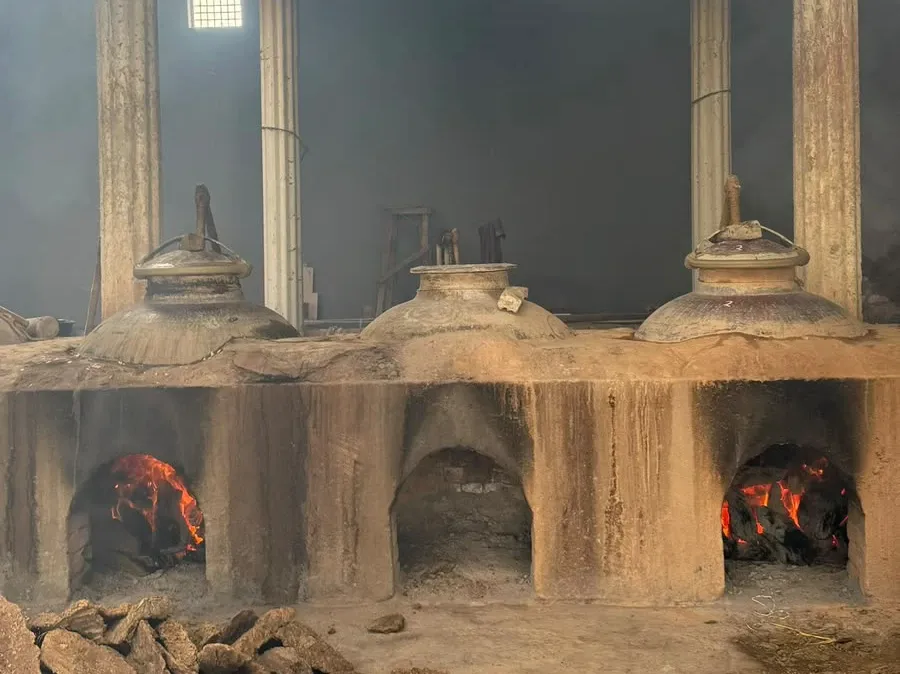
Reports from Kannauj describe the general process like this:
- Clay. Unglazed clay from the topsoil is baked in a kiln, often by local potters, then broken into pieces.
- The deg. The baked clay goes into a copper deg with water. The lid is sealed with a clay and cotton paste so no steam escapes.
- The fire. The deg sits on a brick-and-clay furnace and is heated slowly with wood or similar fuel.
- The bhapka. Steam travels through a bamboo pipe into the bhapka, a long-necked copper pot standing in a tank of cool water. Inside is the base oil, traditionally sandalwood, which soaks up the earthy vapour.
- Repeat. The same oil is put through many rounds of distillation until the smell is strong enough.
The National reports two interesting details from Kannauj perfumers. First, the monsoon is the worst time to make mitti attar, because wet clay loses its smell. Second, only about one in ten Kannauj attar units makes mitti attar at all, according to the government-run Fragrance and Flavour Development Centre.
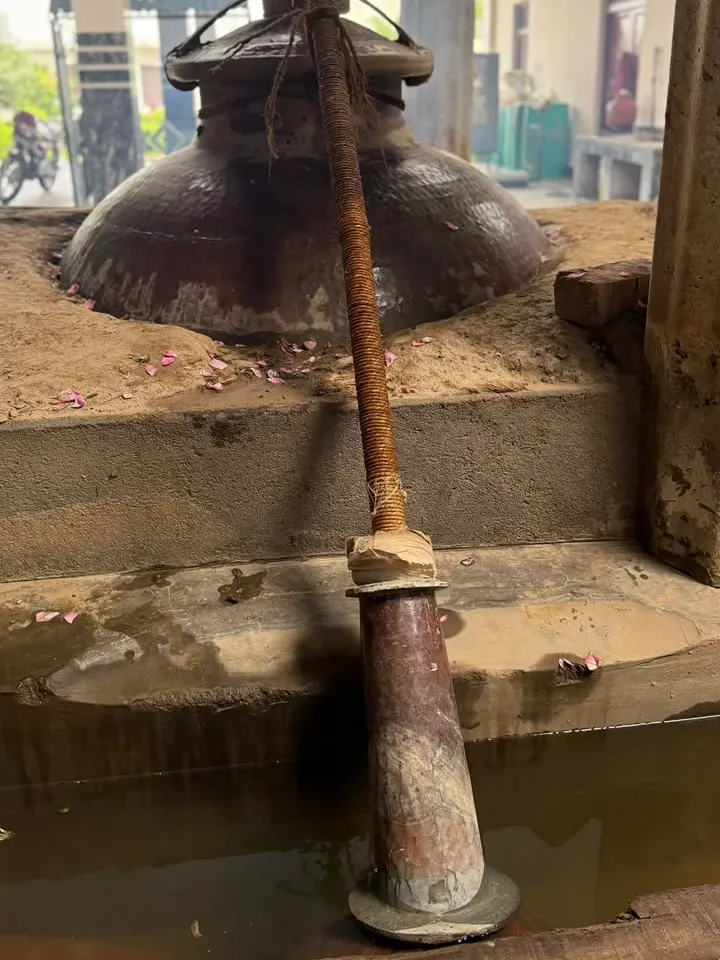
How our Mitti attar is made
Our Mitti attar is one of the three attars we distil ourselves. We distil baked clay into sandalwood oil by deg-bhapka at our own unit in Kannauj, so the earthy note comes from the clay itself. (Our Khus and Shamama are made the same way; our other attars are blends made with imported fragrance oils and bottled in Kannauj.)
Kannauj’s tradition is protected: “Kannauj Perfume” is a registered Geographical Indication. Only authorised users may use the GI on their products, and Syed Scents is not one of them, so our attars do not carry the GI tag.
What does mitti attar smell like?
Think of a clay matka filled with water, or a kulhad of chai on a hot day. A good mitti attar smells of:
How it smells and when to wear it
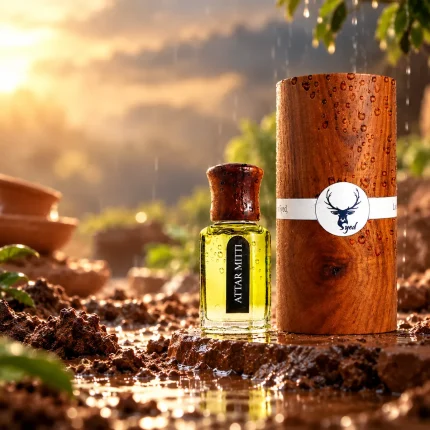
Notes and strength for our Mitti attar, from the product page. A light attar stays close to the skin.
It is not sweet, not floral and not “fresh” in the way an aqua perfume is fresh. It is calm and grounding. Some people love it at first sniff; others find it strange because it smells of soil rather than of a perfume. If you are not sure, start with a 6 ml bottle.
How to wear mitti attar
- Apply on pulse points. One or two swipes on the wrists, behind the ears or on the side of the neck is enough.
- Don’t rub. Let the oil settle on its own.
- Try it on clothes carefully. Oil can mark light fabric, so test on an inside seam first.
- Layer it. Mitti sits nicely under a rose or a soft chandan. Try it with our Rose attar or Chandan attar.
- Patch test first. Alcohol-free does not mean allergy-free. Try a small amount on your inner arm before wearing it widely.
How long it lasts depends on your skin, the weather and how much you apply. Mitti is a light attar, so it stays close to you rather than filling a room. Heavier base notes such as woods and resins last longer on skin, as our guide to attar vs perfume explains.
How to tell a real mitti attar
Because mitti attar is slow to make, cheaper “mitti perfumes” are common. A few simple checks help:
| Check | Good sign | Red flag |
|---|---|---|
| Smell | Baked clay and dry wood, a little smoky | Sweet, sugary or “aqua” rain smell |
| Feel | Oily, no sting on the skin | Watery, cold, or a sharp alcohol smell |
| Label | Says how it is made and what the base oil is | Only says “rain perfume” with no details |
| Price | Reasonable for slow distillation | Very cheap for a large bottle |
| Seller | Answers questions about the base and the process | Can’t tell you how it is made |
We go through these checks in more detail in the reality behind cheap and original attar.
Mitti attar price
Prices vary a lot, mainly with the base oil. National Geographic notes that pure Mysore sandalwood oil became much more expensive after the government restricted sandalwood sales in the late 1990s, and some makers now use cheaper bases. A mitti attar on real sandalwood oil costs more than one on a neutral oil.
Our Mitti attar starts from ₹699 for 6 ml and also comes in 12 ml. Delivery is free across India on orders of ₹999 and above.
Who should try mitti attar?
- People who find most perfumes too loud or too sweet.
- Anyone who wants a quiet scent for the office or college.
- People who love the smell of a new clay pot or the first rain.
- Gift buyers looking for something very Indian and a little unusual. Mitti is a good pick for our 4-attar gift box; see our attar gift guide for ideas.
Questions
What is mitti attar made of?
Traditional mitti attar is made from baked clay and a base oil, usually sandalwood oil. The clay is heated with water in a copper deg, and the earthy vapour is collected in the oil in a bhapka. Our Mitti attar is made this way at our own unit in Kannauj.
Does mitti attar really smell like rain?
It smells like rain on dry earth, the smell called petrichor. It is earthy and mineral, like a wet clay pot, rather than like water or a sweet “fresh” perfume.
Is mitti attar alcohol-free?
A traditional mitti attar is oil-based with no alcohol. All Syed Scents attars, including Mitti, are oil-based and alcohol-free roll-ons.
When should I wear mitti attar?
It is a light scent, so it suits daytime, the office, college and hot weather, especially summer and the weeks before the monsoon. For a winter evening, a stronger attar such as Shamama is a better choice.
Is mitti attar for men or women?
Both. Scent has no gender, and the earthy smell of mitti suits anyone who likes calm, natural-smelling fragrances. See our guides to attar for women and the best attar for men for more picks.
Why is mitti attar not made in the monsoon?
Kannauj perfumers say clay holds too much moisture in the rainy season and loses its smell, so mitti attar is usually made in the dry months.
Want to try it? Explore our Mitti attar, browse all our attars, or message us on WhatsApp and the Syed Scents team will help you choose.
Sources
- The National: How perfumers in India’s fragrance capital bottle the sweet smell of rain (2023)
- National Geographic: This ancient city is the perfume capital of India
- Wikipedia: “Petrichor” (Bear and Thomas, Nature, 1964; geosmin)
- Geographical Indications Registry, Government of India: “Kannauj Perfume”, application 157
- Wikipedia: “Note (perfumery)” (base notes and longevity)
Shop the attars
More guides
 GuideHow to make perfume last longer in Indian weatherWhy perfume fades, the simple steps that make it last, our own 12-hour routine with two sprays, and how perfume…Read more
 GuideEDP vs EDT vs extrait de parfum: what the labels meanEDP means eau de parfum. Here is how EDT, EDP and extrait de parfum differ in perfume oil, wear time…Read more
 GuideOud Attar: Real Oud vs Oud Accord, Types and PriceReal oud is oil from rare agarwood; most oud attars use an oud accord. Here is the difference, what white…Read more