
Original Attar vs Cheap Attar: Why Prices Differ and How to Judge Quality
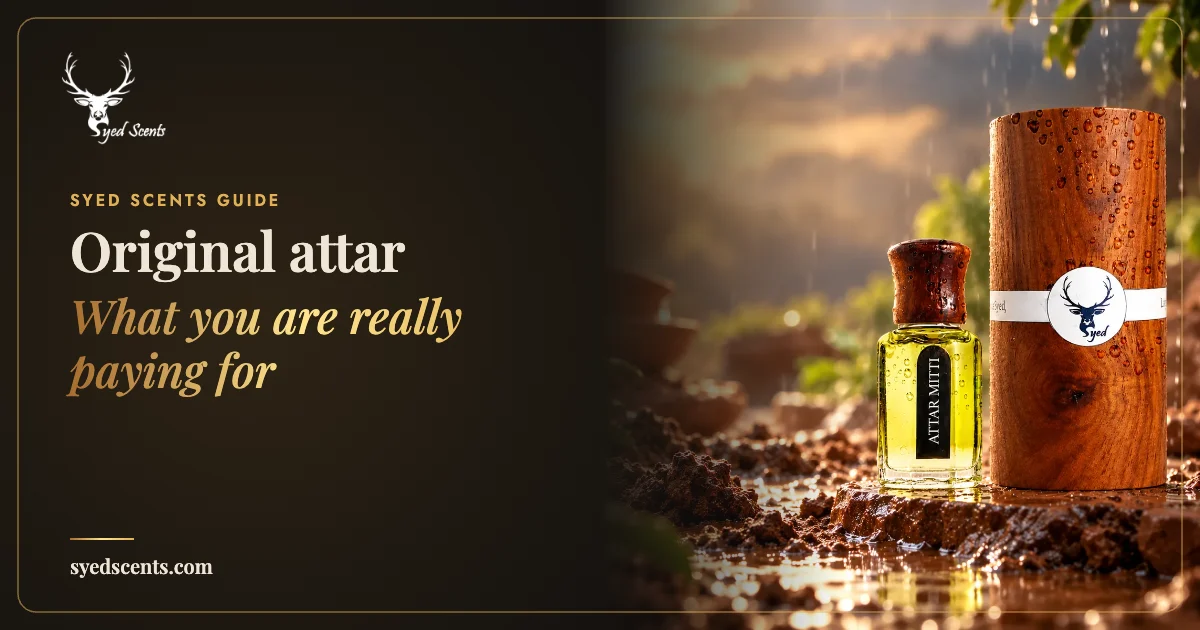
An original attar is one that is honestly what its label says: distilled or blended, on a stated base oil, from a seller who tells you which. Prices differ mainly because of the raw material (rose, agarwood, sandalwood or fragrance oils) and the base oil (sandalwood oil costs many times more than liquid paraffin). Popular home tests like the paper test cannot prove purity; clear labelling, a realistic price and a trusted seller tell you more.
- “Original” does not mean “distilled”. Blends made with fragrance oils are real attars too, as long as they are sold as blends.
- The base oil is a big cost driver: a 2008 Business Today report put sandalwood oil at about ₹90,000 a kilo against about ₹10,000 for liquid paraffin.
- “Pure” and “natural” have no fixed meaning on an attar label in India, so read what the seller actually says is inside.
- The paper test and the water test cannot tell you whether an attar is pure or original.
- A very low price for “pure oud” or “pure sandalwood” is a red flag; a high price on its own is not proof of quality.
- Test any new attar on a small patch of skin before wearing it.
Two attars can look the same and still differ ten times in price. Buyers keep asking us: is a cheap attar fake, how do you spot an original attar, and which home tests work? This post answers honestly, including where popular advice is wrong. For the basics of what attar is and how it is made, see our attar guide.
Why do attar prices differ so much?
Three things set most of the price: how the attar is made, what it is made in, and what it is made from.
Distilled or blended
A distilled attar is made by the deg-bhapka method: flowers, roots or baked clay are heated with water in a copper still, and the scented steam passes into a receiver of base oil. National Geographic describes one rose batch taking about five to six hours, repeated with fresh petals on the following day to build strength. That is slow, fuel-hungry work.
A blended attar is made by mixing fragrance oils into a carrier oil. It is quicker, more consistent, and allows scents that cannot be distilled, such as aqua notes. A blend is not a fake. It becomes a problem only when it is sold as something it is not.
The base oil
Traditional attars are distilled into sandalwood oil. As sandalwood became scarce and costly, many makers switched to cheaper carriers. A 2008 Business Today report on Kannauj quoted makers paying about ₹90,000 a kilo for sandalwood oil against about ₹10,000 for liquid paraffin, and said the share of sandalwood-based attars had fallen from about 80% to about 10% in six years, with liquid paraffin or DOP making up the rest. The figures are old, but the point stands: the base oil alone can change the cost several times over.
The raw material
Some materials are simply rare. National Geographic reports that a kilo of Kannauj rose attar can fetch up to $3,000, and top-quality agarwood (the source of real oud) has reached up to USD 100,000 a kilo, according to ITTO. A few millilitres of either cannot sell for the price of a snack. Our post on the most expensive attars in India covers these materials in detail.
What “original”, “pure” and “natural” can and cannot mean
- Original attar should mean the attar is what the seller says it is: distilled or blended, with the base and main notes stated. It does not have to mean distilled. “Original” is also used for “not a copy of a branded perfume”, which is a different thing.
- Pure attar has no fixed standard for attars in India. Some sellers mean “no alcohol”, some mean “no added carrier”, some mean nothing at all. Ask which.
- Natural attar usually means distilled from plant material. Even then, a label can be wrong. In a 2021 study in Molecules, lab tests on six commercial oils sold as sandalwood found that none met the ISO standard, two were synthetic mixtures, and the packaging was accurate for only three.
That study is the honest lesson: labels and price are not proof. The authors also noted that price was not a reliable sign of quality, though an oil priced like a cheap everyday oil is unlikely to be real sandalwood.
Original oud attar and musk attar: the special cases
Oud. Real oud oil comes from agarwood, which comes mainly from Aquilaria and Gyrinops trees. All these species have been listed under CITES Appendix II since 2004, and good oil is very expensive. So most affordable “oud attars” use an oud-style accord. That is fine if it is said plainly. Ours do: Oud Hindi and our other oud attars use an oud-style accord, not pure agarwood oil.
Musk. Natural musk comes from the musk deer, and getting it means killing the animal. According to Wikipedia’s overview of musk, most musk used in perfumery today is synthetic and the natural musk trade is controlled under CITES. When you search for an “original musk attar”, what you can realistically expect is a well-made musk blend, honestly described. Our Sweet Musk is a blend made with imported fragrance oils.
Home tests: what works and what is a myth
Many popular tests sound scientific but prove little. Here is what each one can actually tell you.
- Paper test (a drop on white paper should leave no stain). Not reliable for attar. A lab that tests oils, the Aromatic Plant Research Center, found heavy oils like vetiver do not fully evaporate, while synthetic adulterants can evaporate like the real thing. A distilled attar sits in a heavy base oil, so it will mark paper too.
- Water test (real attar floats or does not mix). Every oil floats on water and does not mix with it, paraffin included. It tells you nothing about quality.
- “Stronger smell means purer”. Not true. Strength depends on the blend and its notes; a sharp, loud opening can come from either kind.
- “Thick and dark means original”. Not on its own. Colour and thickness depend on the ingredients and the base.
- Wear it for a day. Useful for judging quality, not purity. A good attar changes over hours, from the first notes to a softer base. Heavier base notes such as woods and resins last longer.
- Patch test. Useful for safety. Try a little on a small patch of skin before regular use, as our guide to wearing attar advises.
The only way to prove what is in a bottle is lab analysis, such as gas chromatography. For a normal buyer, the practical checks are below.
How to judge an attar before you buy: 5 checks
How to judge an attar: 5 checks
- 1Label
Good signSays distilled or blend; names the main notes
Red flagOnly “100% pure” or “original”, no detail
- 2Base oil
Good signThe seller tells you the carrier oil
Red flagNo answer
- 3Price
Good signFits the material
Red flag“Pure oud” at an everyday price
- 4Seller
Good signNamed, contactable, clear policies
Red flagNo address or contact
- 5Wear test
Good signChanges over a few hours; patch test first
Red flagFades fast, turns harsh, or your skin reacts
Paper and water tests cannot prove purity. Only lab analysis can.
| Check | What a good sign looks like | Red flag |
|---|---|---|
| 1. Label | Says whether it is distilled or a blend, and names the main notes | Only “100% pure”, “100% natural” or “original” with no detail |
| 2. Base oil | The seller can tell you what the carrier is | No answer, or “secret” |
| 3. Price | Fits the material: real oud, rose or sandalwood cost a lot | “Pure oud” or “pure sandalwood” at an everyday price |
| 4. Seller | Named business, contact details, clear returns and delivery terms | No address, no contact, no policy pages |
| 5. Wear test | Opens, settles and changes over a few hours; no irritation on a patch test | Smell vanishes quickly or turns harsh; skin reacts |
Red flags when buying attar online
- Health or medical promises, such as curing headaches or stress.
- “Original oud” or “real kasturi” at a few hundred rupees.
- The same “pure” claim on every product, whatever it is made of.
- Hour counts for longevity with no explanation of how they were measured.
- No way to ask a question before you pay.
A cheap attar is not automatically bad. A low-priced blend that says it is a blend can be a perfectly good daily scent. The problem is a cheap attar dressed up as a rare one.
Where Syed Scents stands
We sell both kinds and say which is which on every product page. Mitti (baked clay distilled into sandalwood oil), Khus and Shamama are distilled by deg-bhapka at our own unit in Kannauj. Our other attars are blends made with imported fragrance oils and bottled in Kannauj. All are oil-based and alcohol-free, in 6 ml and 12 ml roll-ons, starting from ₹599 for 6 ml. If you are unsure, a 4-in-1 gift box lets you try four attars before buying a larger bottle, or browse the full attar collection. If you are weighing attar against a spray, read attar vs perfume.
Questions
How can I identify an original attar?
Check that the label says whether it is distilled or a blend and names its main notes, that the price fits the material, and that the seller is named and contactable. Then wear it for a few hours. No home test proves purity; only lab analysis can.
Is a cheap attar always fake?
No. Many low-priced attars are honest blends of fragrance oils. A cheap attar is a problem only when it claims to be a rare distilled oil, such as pure oud, rose or sandalwood, that cannot be sold at that price.
Does the paper test show if an attar is pure?
No. Heavy natural oils can leave a mark on paper, and synthetic adulterants can evaporate cleanly. Distilled attars sit in a heavy base oil, so they mark paper as well. The test cannot separate original from imitation.
What is the difference between pure attar and natural attar?
Neither term has a fixed meaning on attar labels in India. “Natural” usually means distilled from plant material; “pure” may mean alcohol-free or undiluted. Ask the seller what the attar is made from and what the base oil is.
Is an affordable oud attar real oud?
Usually not. Real oud oil comes from agarwood, which is rare, CITES-listed and very expensive. Most affordable oud attars use an oud-style accord, which is fine when the seller says so. Syed Scents oud attars use an oud-style accord.
Sources
- Business Today (July 2008), “Fleeting fragrance”, report on sandalwood vs liquid paraffin bases in Kannauj: businesstoday.in
- National Geographic, “This ancient city is the perfume capital of India” (deg-bhapka, rose attar price, base oils): nationalgeographic.com
- Kucharska et al. (2021), “A Comparison of the Composition of Selected Commercial Sandalwood Oils with the International Standard”, Molecules 26(8):2249: pmc.ncbi.nlm.nih.gov
- ITTO (November 2022), news release on the ITTO–CITES agarwood report: itto.int
- Aromatic Plant Research Center, “The Paper Test” (limits of the paper test): aromaticplant.org
- Wikipedia, “Musk” (general definition, synthetic musk, CITES): en.wikipedia.org
Not sure which attar suits you? Message the Syed Scents team on WhatsApp and we will help you choose.
Shop the attars
More guides
 GuideHow to make perfume last longer in Indian weatherWhy perfume fades, the simple steps that make it last, our own 12-hour routine with two sprays, and how perfume…Read more
 GuideEDP vs EDT vs extrait de parfum: what the labels meanEDP means eau de parfum. Here is how EDT, EDP and extrait de parfum differ in perfume oil, wear time…Read more
 GuideMitti Attar: The Smell of First Rain, ExplainedMitti attar is the smell of first rain on dry earth, distilled from baked clay into sandalwood oil in Kannauj.…Read more